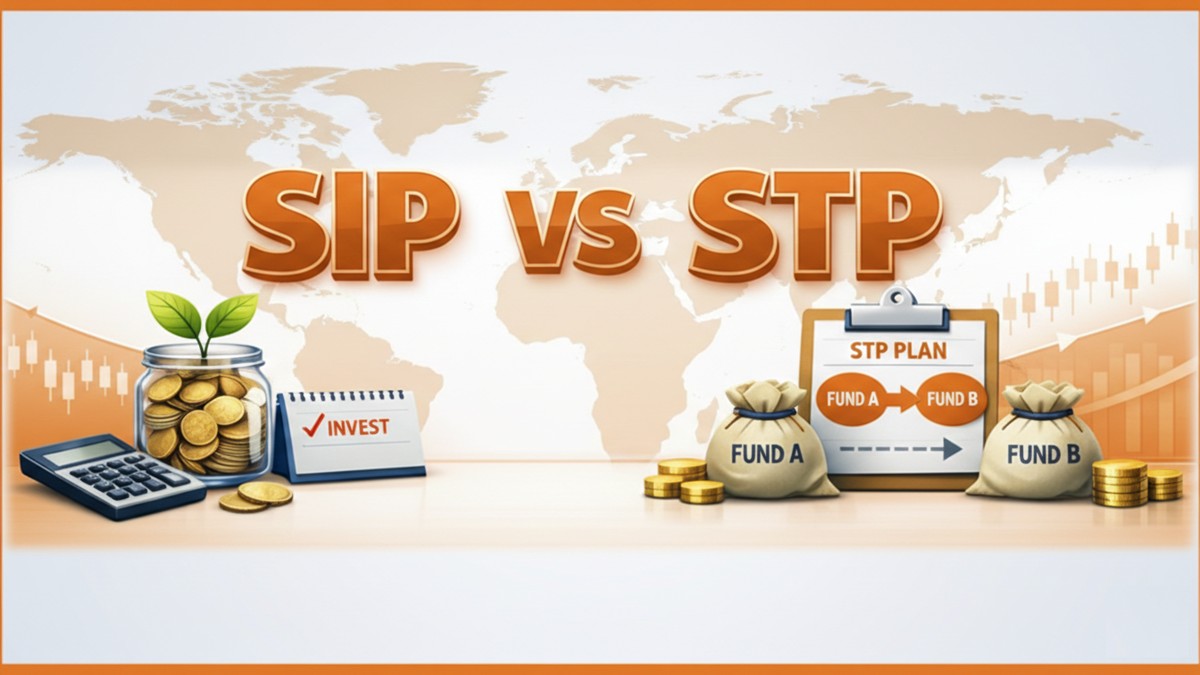
What Is a Systematic Investment Plan (SIP)?
A Systematic Investment Plan (SIP) is a structured investment approach offered by mutual funds that allows investors to contribute a fixed amount to a chosen fund at regular intervals. With contributions starting as low as ₹100, SIPs make investing accessible and convenient through automatic bank debits eliminating the need for manual payments. This method encourages disciplined investing, helps manage market volatility through rupee cost averaging and supports gradual wealth creation over the long term. By committing to a fixed sum consistently regardless of market conditions, SIPs provide a simple and effective way for investors to build wealth steadily without the challenge of timing the market.What Is a Systematic Transfer Plan (STP)?
A Systematic Transfer Plan (STP) is an investment facility offered by mutual funds that enables investors to move a fixed amount of money from one mutual fund scheme to another at regular intervals such as daily, weekly, monthly etc. Typically funds are transferred from a low risk scheme such as a debt fund to a higher growth scheme like an equity fund. STPs help manage market volatility by reducing the risk of investing a large sum at the wrong time, promote disciplined investing and take advantage of rupee cost averaging.Key Differences between SIP and STP
| Feature | Systematic Investment Plan | Systematic Transfer Plan |
| Investment Approach | Invests a fixed small amount at regular intervals (monthly, weekly etc.) | Transfers a fixed amount periodically from one mutual fund scheme to another |
| Fund Source | Directly debited from the investor’s bank account | Comes from an existing investment, usually a debt or liquid fund |
| Suitable For | Investors with regular income and monthly savings | Investors holding a lump sum who want gradual market entry |
| Investment Starting Point | Can begin with a small amount (e.g., ₹100 or ₹500 depending on scheme) | Requires an initial lump sum investment in a source scheme |
| Rupee Cost Averaging | Yes, averages purchase cost across market cycles | Indirect benefit while moving gradually from one scheme to another |
| Flexibility | Amount, frequency and duration can usually be modified or paused | Transfer amount, frequency and tenure can be adjusted within scheme rules |
| Use Case | Suitable for investors who prefer investing regularly through periodic contributions aligned with their cash flows and long-term financial goals. | Suitable for investors who have an existing lump sum investment and wish to transfer it gradually to another scheme for phased market participation or asset allocation. |
| Tax Implication | Each SIP installment is treated as a separate investment for taxation | Every transfer is considered a redemption from the source fund and may trigger capital gains tax |
| Automation Benefit | Encourages disciplined saving and investing habit | Enables structured reallocation without manual switching |
| Liquidity Impact | Linked to liquidity of the chosen scheme | Depends on liquidity of both source and target schemes |
SIP or STP - What to choose?
The decision to invest through a Systematic Investment Plan (SIP) or a Systematic Transfer Plan (STP) depends on your financial goals and investment horizon. SIPs are suitable for investors who wish to invest small amounts regularly enabling disciplined, long term wealth creation while averaging market volatility. STP in mutual fund are suitable for investors who wish to systematically transfer a lump sum between mutual fund schemes either from debt or liquid funds to equity to reduce market timing risk or from equity to debt to gradually secure gains and reduce volatility exposure.Pros and Cons of SIP and STP
SIP Pros- Encourages disciplined investing through regular, automatic contributions.
- Reduces the impact of market volatility by spreading investments over time (rupee cost averaging).
- Removes the need to time the market for each investment.
- Requires a commitment to invest consistently over time.
- May generate lower short term returns if markets rise sharply immediately after the first installment.
- Does not eliminate market risk, returns can still fluctuate.
- Allows gradual transfer of a lump sum from one fund to another reducing market timing risk.
- Useful for moving large amounts into volatile assets like equity systematically.
- Keeps funds productive in the source fund while transferring.
- Helps maintain a balanced portfolio by re-allocating between asset classes gradually.
- Requires an initial lump sum to start the transfers.
- Transfers may be considered partial redemptions which could have tax implications.
STP and SIP - Which is a Better Investment Option?
Choosing between a SIP (Systematic Investment Plan) and an STP (Systematic Transfer Plan) depends on an investor’s financial situation, goals and risk appetite.- SIPs are designed for investors who earn a regular income and wish to grow wealth steadily over time. SIPs promote financial discipline and reduce the impact of market volatility through rupee cost averaging. One of the key benefits of SIP is that it allows investors to gradually build wealth without worrying about market timing. This makes SIPs particularly suitable for long term goals such as retirement planning, funding children’s education or wealth accumulation. Over time the compounding effect and consistent investing help investors make the most of their savings.
- STPs on the other hand are suitable for investors who already have a lump sum amount for example from savings, bonuses or inheritance. Instead of investing the entire amount in equities at once which can be risky in volatile markets, STPs allow a systematic transfer of funds from safer instruments like debt or liquid funds into equity funds. This gradual approach reduces market timing risk while keeping the unused portion productive in low risk instruments. STPs are also useful for rebalancing portfolios or locking in profits from equity gains over time.
Conclusion
Both SIPs and STPs are valuable tools for building and managing a mutual fund portfolio but their suitability depends on an investor’s financial situation and goals. SIPs are suitable for regular investors seeking disciplined, long term wealth creation while STPs are more suitable for deploying existing lump sums systematically to balance risk and market exposure. Ultimately the choice between SIP and STP should align with your investment horizon, available funds and risk tolerance enabling a structured and effective approach to wealth creation.FAQ
1) Are SIPs and STPs subject to market risks? Yes. Both SIPs (Systematic Investment Plans) and STPs (Systematic Transfer Plans) involve investing in mutual funds which are subject to market fluctuations.
2) Can I invest in SIP and STP simultaneously? Yes. Investors can use both strategies together. For example you can continue making regular contributions through a SIP while systematically transferring a lump sum via an STP from a liquid or debt fund to an equity fund. Combining both strategies helps optimize portfolio growth while managing risk and market exposure.
3) Are SIPs and STPs suitable for all types of investors? Not necessarily. SIPs are suited for investors with regular income who want to build wealth gradually. STPs are suitable for those with a lump sum who want to move funds systematically between schemes typically from low risk to higher risk investments. Investors should assess their financial goals, risk tolerance and investment horizon before choosing either or both strategies.
4) Can I stop or modify my SIP or STP? Yes. Both SIP and STP generally offer flexibility to pause, stop or modify the investment amount, frequency or tenure subject to the terms of the respective mutual fund scheme.
Disclaimers Investors may consult their Financial Advisors and/or Tax advisors before making any investment decision. These materials are not intended for distribution to or use by any person in any jurisdiction where such distribution would be contrary to local law or regulation. The distribution of this document in certain jurisdictions may be restricted or totally prohibited and accordingly, persons who come into possession of this document are required to inform themselves about, and to observe, any such restrictions. MUTUAL FUND INVESTMENTS ARE SUBJECT TO MARKET RISKS, READ ALL SCHEME RELATED DOCUMENTS CAREFULLY.
Disclaimers
Investors may consult their Financial Advisors and/or Tax advisors before making any investment decision.
These materials are not intended for distribution to or use by any person in any jurisdiction where such distribution would be contrary to local law or regulation.
MUTUAL FUND INVESTMENTS ARE SUBJECT TO MARKET RISKS, READ ALL SCHEME RELATED DOCUMENTS CAREFULLY