
Net Asset Value Meaning – NAV Full Form & Definition
NAV (Net Asset Value) represents the per-unit value of a mutual fund scheme and is the price at which investors buy or redeem units. In simple terms, it reflects the current value of the fund's total assets minus its liabilities, divided by the number of units outstanding. As per regulatory guidelines, mutual fund schemes disclose NAV at the end of each business day. As you explore the broader mutual fund meaning, NAV becomes a key concept in understanding how investments are valued. You can think of NAV as similar to a share price. Just as a share price indicates the value of one share of a company, NAV reflects the value of one unit of a mutual fund. However, unlike stock prices that fluctuate based on demand and supply, NAV is derived from the market value of the underlying portfolio of securities held by the fund.NAV Formula – How Net Asset Value is Calculated
The NAV of a mutual fund scheme is calculated using a straightforward formula: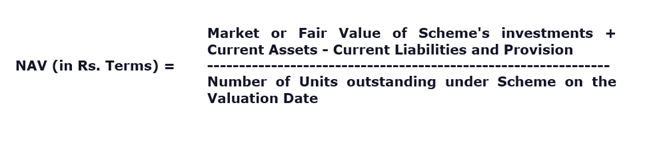
What Counts as Assets in a Mutual Fund?
Assets represent the total value of what the fund owns. This includes:- Market value of securities (equity, bonds, government securities, money market instruments)
- Cash and cash equivalents
- Accrued income (dividends and interest receivable)
- Other receivables
What Counts as Liabilities in a Mutual Fund?
Liabilities are the expenses and obligations of the fund such as:- Accrued management fees
- Administrative and transaction costs
- Redemption payables
- Other accrued expenses
Step by Step NAV Calculation with Worked Example
Let's understand NAV with a simple example: Example- Total assets = ₹512 crore
- Total liabilities = ₹1 crore
- Net assets = ₹511 crore
- Total units = 5.11 crore
High NAV vs Low NAV – The Myth Every Investor Gets Wrong
A common misconception among investors is that a mutual fund with a lower NAV is cheaper and a better investment. NAV is simply the per-unit price of a fund. What really matters is the percentage growth in NAV, not its absolute value. Let's understand this with a simple example:- You invest ₹10,000 in Fund A (NAV ₹10) – you get 1,000 units
- You invest ₹10,000 in Fund B (NAV ₹500) – you get 20 units
NAV vs Stock Price – Key Differences
| Aspect | NAV (Mutual Fund) | Stock Price |
| How it is set | Calculated using a formula (assets – liabilities) ÷ total units | Determined by demand and supply on the exchange |
| Frequency of update | Once per business day (after market close) | Continuously during market hours |
| Entry / Exit price | End of day NAV (subject to cut off time) | Real time market price at execution |
Growth Plan NAV vs IDCW Plan NAV
When you explore IDCW vs Growth, you will notice that the same mutual fund has different NAVs depending on the plan.- In the Growth plan, all earnings remain invested in the fund and continue to compound over time. As a result, the NAV typically grows steadily.
- In the IDCW plan, the fund may distribute a portion of its gains to investors from time to time. Whenever such a distribution is made, the NAV falls to the extent of the payout per unit on the ex-date.
NAV and SIP – How NAV Determines the Units You Get
When you invest through a Systematic Investment Plan (SIP), your fixed instalment buys mutual fund units at the prevailing NAV on the SIP date. Units allotted = SIP Amount ÷ NAV on SIP date Since NAV changes with market movements, the number of units you receive also varies:- When markets are down (lower NAV) – you get more units
- When markets are up (higher NAV) – you get fewer units
NAV Cut-Off Time – SEBI's 3 PM Rule Explained
SEBI has defined cut-off timings that determine which day's NAV you receive when you invest or redeem in a mutual fund.| Type of Schemes | Transaction Type | Cut-off Timings |
| Liquid Funds & Overnight Funds | Subscription (including switch-in from other schemes) | 1:30 p.m. |
| Liquid Funds & Overnight Funds | Redemption (including switch-out to other schemes) | 3:00 p.m. |
| All other schemes (other than Liquid / Overnight Funds) | Subscription (including switch-in from other schemes) | 3:00 p.m. |
| All other schemes (other than Liquid / Overnight Funds) | Redemption (including switch-out to other schemes) | 3:00 p.m. |
How to Check Current NAV of Any Mutual Fund?
-
Association of Mutual Funds in India (AMFI) Website
The AMFI website is the most reliable source to check NAV. It publishes daily NAV for all registered mutual fund schemes. -
Fund House Website or App
Every mutual fund company updates the NAV of its schemes on its website and mobile app by the end of each business day. -
Investment Platforms & Apps
Most investment platforms and apps provide easy access to NAV details across multiple funds. These platforms typically display both current and historical NAV, helping you track your investments conveniently in one place.
Conclusion
Net Asset Value (NAV) is a foundational concept that helps you understand how mutual funds are priced and how your investments grow over time. While it determines the price at which you buy and redeem units, it should not be the sole factor in your investment decision. Instead, focus on the fund's overall performance, consistency and underlying portfolio. Equally important is keeping an eye on costs such as the expense ratio, as these directly impact your net returns over the long term. By combining a clear understanding of NAV with a disciplined investment approach, you can make more informed and effective mutual fund decisions.FAQ
1) What is NAV in mutual fund? NAV (Net Asset Value) is the per-unit price of a mutual fund scheme. It represents the value of the fund's total assets minus liabilities, divided by the number of outstanding units. 2) What is the full form of NAV? NAV stands for Net Asset Value. 3) Is a lower NAV better for mutual fund investment? Not necessarily. A lower NAV does not mean a fund is cheaper or better. What matters more is the fund's performance, portfolio quality and consistency over time – not its NAV level. 4) How is NAV calculated? NAV is calculated using the formula: (Total Assets − Total Liabilities) ÷ Total Number of Units Outstanding 5) Does a high NAV mean a fund is expensive? A high NAV simply indicates that the fund's value has grown over time. It does not make the fund expensive or less attractive compared to a fund with a lower NAV. 6) What is the NAV cut-off time for mutual funds? For most equity and hybrid funds, the cut-off time is 3:00 PM. For liquid and overnight funds, it is typically 1:30 PM for purchases. Transactions submitted before the cut-off time get the same-day NAV (subject to fund realisation). 7) Why does the same mutual fund have two different NAVs? A mutual fund may offer different plans such as Direct and Regular. Each plan has a different NAV due to varying expense ratios, even though they invest in the same underlying portfolio. 8) How does NAV affect SIP investments? In SIPs, you invest a fixed amount regularly and units are allotted based on the prevailing NAV. When NAV is lower, you get more units and when it is higher you get fewer units – this helps average out the cost over time (rupee cost averaging). 9) Where can I check the NAV of a mutual fund? You can check NAV on the Association of Mutual Funds in India (AMFI) website, the fund house's official website/app or through investment platforms that provide consolidated portfolio tracking.Disclaimers Investors may consult their Financial Advisors and/or Tax advisors before making any investment decision. These materials are not intended for distribution to or use by any person in any jurisdiction where such distribution would be contrary to local law or regulation. The distribution of this document in certain jurisdictions may be restricted or totally prohibited and accordingly, persons who come into possession of this document are required to inform themselves about, and to observe, any such restrictions. MUTUAL FUND INVESTMENTS ARE SUBJECT TO MARKET RISKS, READ ALL SCHEME RELATED DOCUMENTS CAREFULLY
Disclaimers
Investors may consult their Financial Advisors and/or Tax advisors before making any investment decision.
These materials are not intended for distribution to or use by any person in any jurisdiction where such distribution would be contrary to local law or regulation.
MUTUAL FUND INVESTMENTS ARE SUBJECT TO MARKET RISKS, READ ALL SCHEME RELATED DOCUMENTS CAREFULLY